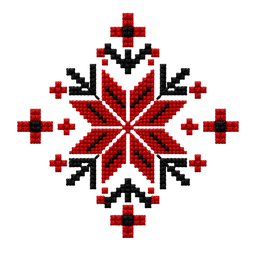
A collective fabric of belonging
A quilt of stories.
During the isolation of the pandemic, members of Minnesota’s Romanian community recreated ancestral embroidery motifs. Brought together in one quilt, these individual stitches became a shared expression of memory and belonging.
Explore the quilt ↗
 From the community quilt
A closer look
A world within
every stitch.
Patterns once carried on blouses now meet in a new home. Look closely: each cross of thread records the patience and care of a person.
Look inside the quilt ↗The people behind Crossing Threads
Made together.
Remembered together.
During the pandemic, friends and members of Minnesota’s Romanian community returned to ancestral embroidery motifs. Their individual work became a collective fabric of belonging.
Curated by Monica von Geldern
Quilt created by Nanette Missaghi.
“In the quiet repetition of stitches, time folds upon itself.”From the exhibition text
About the exhibition
Traditionally, the making of Romanian folk blouses was an intimate and solitary act. Through the long Romanian winter evenings, when daylight disappeared early and villages grew quiet, needle and thread kept a slow measure of time. Stitch after stitch, intricate patterns emerged from the fabric. In that solitude, the maker remained connected to those who had come before her, preserving stories, places, and identities through this seemingly modest gesture.
Decades later, another kind of solitude entered our lives. During the isolation of the pandemic, time once again became strangely suspended. Separated from one another, confined to our homes, we found ourselves searching for ways to remain connected to memory, to tradition, and to one another. Recreating these ancestral motifs became an act of continuity. The same patterns that had once been patiently stitched through winter nights were brought back to another season of isolation. The needle crossed the fabric as it had generations before, turning solitude into presence and silence into a form of connection.
Crossing Threads is therefore more than an assemblage of decorative motifs. It is a meeting of two kinds of isolation, separated by time yet joined by the human need to make, remember, and belong. Threads from distant homes and threads from a recent collective experience converge here, creating a fabric in which personal memory becomes shared memory.
In the quiet repetition of stitches, time folds upon itself. What was once carried from a homeland becomes, once again, a way of finding home.
The quilt: a collective fabric of belonging
The textile art installation, Crossing Threads, is made from over 120 patches of cross-stitched motifs, recreated by over 23 embroiderers, friends and members of the local Romanian community.
The patches were assembled using the traditional method of quilting, an American textile tradition, bringing together Romanian embroidery heritage and the American practice of quiltmaking in one collective work.
Individual patterns, once part of personal garments and histories, are brought together here as an expression of collective memory and belonging. The patches are attached to black wool fabric woven on a traditional loom in a village in the Muscel region of Romania. It is the cloth from which the FOTA (FOH-tuh) is made, a wraparound skirt worn with the traditional Romanian blouse. Through it the tapestry is joined to an older tradition of weaving and clothing.
The tree, COPACUL (ko-PAH-kool) stitched to the tapestry draws on a common motif in Romanian textiles and on the universal symbolism of the tree as a sign of roots, ancestry, growth, and belonging. It is made from green fabric traditionally used as belts, BETE (BEH-teh), to hold the woven skirts. Black fabric of the same type traces the outline of Minnesota, giving the tapestry its shape.
This gesture brings together two geographies: Romania, represented through the inherited motifs and materials, and Minnesota, the place where these traditions continue to live and evolve.
This tapestry was created by Nanette Missaghi, following an idea by Monica von Geldern.
It was made possible through the generous donations of the Beveroth and von Geldern families and members of HORA with the broad participation of the Romanian community.
Alexandrina Enăchescu-Cantemir and the book
Born in Câmpulung-Muscel, Alexandrina Enăchescu-Cantemir was a Romanian ethnographer, artist, educator, and pioneering visual documentarian whose life’s work was devoted to recording Romanian traditional costume and rural artistic traditions.
She studied painting with the Romanian painter Sava Henția and later studied at the Franz-Joseph Kunststickerei Schule (Imperial School of Art Embroidery) in Vienna, where she developed her knowledge of embroidery and decorative arts. Upon returning to Romania, she taught embroidery and eventually served as principal of the Tudosca Doamna School of Embroidery, contributing to the education and preservation of traditional textile arts.
Enăchescu-Cantemir traveled throughout Romania, carefully documenting the forms, ornament, colors, and regional variations of traditional dress. Her precise drawings provided an important visual record at a time when photography could not always capture the intricate details and colors of embroidered garments. Her surviving body of work includes more than 1,000 drawings and plates documenting Romanian traditional costume.
In 1938, she published The Romanian Peasant Dress, an album of 140 color lithographs issued in Romanian, French, and English. The plates possess important documentary value, particularly because the use of color preserved the visual character of traditional garments with a precision that contemporary photography could not always provide. The album was presented at the 1939 New York World's Fair, introducing the richness and regional diversity of Romanian traditional costume to an international audience.
Enăchescu-Cantemir’s work remains an important visual archive of Romanian rural culture. Through her careful observation and precise rendering, she preserved patterns, colors, and regional characteristics of traditional dress for future generations, creating a lasting record at the intersection of ethnography, art, and textile tradition.
Images in This Exhibition
The images displayed individually around the ethnographic map of the Romanian regions are reproduced from Enăchescu-Cantemir’s The Romanian Peasant Dress. Presented alongside the map, they offer a visual reference to the regional diversity of Romanian traditional costume and provide historical context for the motifs represented throughout this exhibition.
The original book is preserved as a historical resource and is available for study by appointment only.
Acknowledgments and contributors
HORA extends its gratitude to everyone whose care, creativity, generosity, and collaboration brought this exhibition to life.
Special appreciation to the 24 participants whose creativity, personal stories, textiles, and craftsmanship came together to shape this remarkable textile art installation.
Through their generous contributions of artistic vision, skill, and shared experiences, individual threads became a collective expression of heritage, identity, memory, and connection - transforming many distinct voices into one meaningful work of art.
Aline PetzoldJessica Bortnova
Amy HodgeKatherine Anstett
Ana WesterveltLucia Anderson
Constanta DutaMonica von Geldern
Cornelia StanescuNicoleta Cornea
Cristian WesterveltNina Corondan
Dana VollerOana Zayic
Eugenia CerchizanPasha Bortnova
Genu BordianuRaluca Octav
Gina PopaSarah Haas
Irina Candet Tantzie Korolchuk
Irina WoldeabValentina Liutcan
Curator: Monica von Geldern
Exhibition coordinators: Gina Popa and Dana Voller
Production & installation: Chad Voller
Photography: Krista Paige and Teodora Pogonat
Historical & ethnographic consultant: Raluca Octav
Exhibition venue & institutional support: Minnesota Landmarks
Exhibition website in progress · English edition. A Romanian edition and individual patch stories are being prepared.